
The Pixel 10 Finally Fixed Google’s Biggest Flaw
I’m done apologizing for my phone choice.
For the last four years, recommending a Google Pixel came with a massive asterisk. “The camera is incredible,” I’d tell my friends, “but the battery might die by 4 PM.” Or, “The software is the smartest out there, but don’t play heavy games or it’ll melt a hole in your pocket.”
It was exhausting. I felt like I was making excuses for a brilliant but deeply flawed friend.
I’ve been testing the Pixel 10 Pro for two months now. I’ve run it against the Galaxy S25 Ultra. I’ve compared it to the iPhone 17 Pro. And for the first time since the Nexus 6P days, I don’t have to add a “but” to my recommendation.
The transition to TSMC for the Tensor G5 chip wasn’t just a spec bump. It was a rescue mission.
The Foundry Problem (Or: Why Your Old Pixel Got Hot)
Let’s get technical for a second because this context matters. From the Pixel 6 through the Pixel 9, Google’s custom Tensor chips were modified Exynos processors manufactured by Samsung Foundry. They weren’t bad per se, but they were inefficient compared to the Snapdragon chips powering the Galaxy series.
They ran hot. The modems were notoriously weak. If you were on 5G in a spotty area, your battery would tank because the phone was screaming at the tower trying to maintain a handshake.
The Pixel 10 is different. Google finally moved production to TSMC’s 3nm process—the same fabrication lines that Apple uses. The difference is night and day.
I ran a 45-minute Genshin Impact session on max settings yesterday. On the Pixel 9 Pro, the frame rate would throttle after 15 minutes, and the back glass would get uncomfortable. On the Pixel 10? It got warm. Just warm. Not “I need to put this down” hot. Just “physics is happening” warm. The frame rate stayed pinned at 60fps.
Signal Strength: The Invisible Upgrade
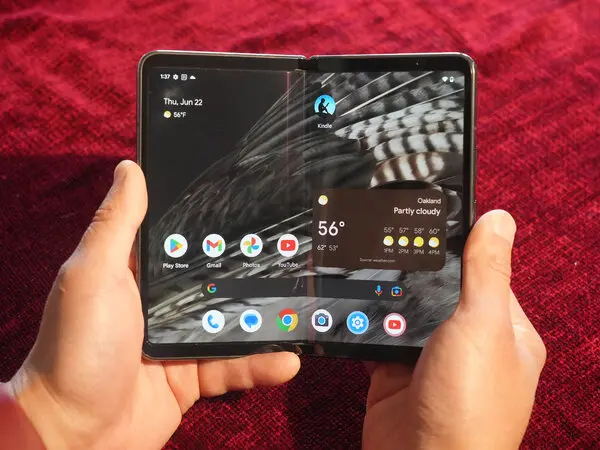
Nobody puts “Better Modem” on a billboard. It’s not sexy. You can’t take a picture of it. But it changes how you actually use the device.
There’s a specific dead zone in my parking garage—level B3, right near the elevator. My S24 Ultra always held a signal there. My Pixel 8 Pro always dropped to “Emergency Calls Only.” It was a reliable test of modem quality.
With the Pixel 10, I’m streaming Spotify all the way to my parking spot. No buffering. No dropouts. I’m not sure if Google is using a new Qualcomm modem or if they heavily customized their own, but the “Exynos Curse” seems to be broken. For a device that is primarily a communication tool, this matters more than any AI wallpaper generator.
Cameras: The Gap Widens Again
Samsung’s S25 Ultra is a beast. The 200MP main sensor captures an absurd amount of detail, and if you need to zoom in 100x to read a license plate down the block, it’s still the king.
But I don’t take photos of license plates. I take photos of my dog, my dinner, and my friends in dimly lit bars.
Google’s image pipeline has shifted this year. They’re leaning less into the “HDR crunch” that defined the Pixel look for a decade and more into natural light falloff. Shadows are actually dark now.
I took a shot of a neon sign reflecting off a wet rainy street last night. The S25 Ultra tried to brighten the shadows, turning the moody black asphalt into a noisy gray sludge. The Pixel 10 let the darkness crush. The contrast popped. It looked like what my eyes saw.
Video is where I’m actually shocked.
Historically, if you cared about video, you bought an iPhone. End of discussion. Android video was jittery, and the exposure stepped visibly when moving from dark to light areas.
The Tensor G5’s ISP (Image Signal Processor) is finally fast enough to apply Google’s HDR+ algorithms to 4K/60fps video in real-time without stuttering. Is it better than the iPhone 17 Pro? Honestly, it’s a toss-up. And “it’s a toss-up” is the highest praise an Android phone can get in the video department.
Software: Android 16 Feels Grown Up
We need to talk about One UI vs. Pixel UI.
Samsung’s One UI 7 (or 7.1 now) is packed with features. Too many features. I spent an hour setting up my S25 Ultra just disabling things. Bixby. The Samsung Keyboard. The duplicate browser. The duplicate gallery. The sidebar I keep accidentally swiping.
Pixel UI on Android 16 feels calm. It’s opinionated—Google decides how the app drawer should look, and you can’t change it much—but the opinions are generally good.
The new “Contextual Hub” on the lock screen is actually useful. It’s not just showing me a generic weather widget; it knew I had a flight, pulled the gate number from my email, and showed me the boarding pass QR code right as I walked up to the scanner. I didn’t have to unlock the phone or dig through an app. It just knew.
That’s the “AI” I care about. Not generating weird pictures of astronauts riding horses. I want my phone to reduce friction in my actual life.
The Battery Life Reality Check
Here are my stats from yesterday:
- 6:30 AM: Unplugged at 100%.
- Commute: 45 mins of podcasts + navigation.
- Work: Slack, emails, a few calls, doom-scrolling Twitter (X) during lunch.
- Evening: 30 mins of YouTube, casting to the TV.
- 11:00 PM: 28% remaining.
On the Pixel 9, I would have been hitting battery saver mode by 8 PM. On the Pixel 10, I stopped carrying a power bank. That psychological shift—losing the “battery anxiety”—is worth the upgrade price alone.
The Verdict
The Galaxy S25 Ultra is a masterpiece of hardware maximalism. If you want a stylus and a screen that gets bright enough to signal the ISS, buy that. It’s a tank. It’s reliable. It’s boring.
The iPhone 17 Pro is… well, it’s an iPhone. It’s excellent and predictable.
But the Pixel 10 is the first time Google has matched that level of hardware reliability while keeping the software magic that makes Pixels fun. It doesn’t feel like a science experiment anymore. It feels like a finished product.
I’ve put my SIM card in a lot of phones this year. This is the one I’m not taking out.