
Why I’m Actually Rooting for an Apple Foldable
I spent nearly two thousand dollars on my latest daily driver, the Galaxy Z Fold 7. The hardware is an absolute marvel. The hinge is invisible, the crease is basically gone, and the battery life finally lasts me a full day of heavy use. From a purely mechanical standpoint, Android Phones have peaked. We won the hardware war years ago.
But then I open a specific banking app, or even a popular social media platform that hasn’t been updated in three weeks, and I’m staring at a stretched-out, ugly mess. Or worse, I get black bars on the sides because the developer couldn’t be bothered to code for a variable aspect ratio.
It’s late 2025, and I am tired of making excuses for the software experience on Android foldables. We have the best gadgets, but we don’t have the ecosystem buy-in from third-party developers. That is why, as much as it pains my Android-loving heart to say this, I am desperate for Apple to release a foldable.
The “Good Enough” Trap
Here is the reality of the current market. Android foldables, despite being in their seventh or eighth generation depending on the manufacturer, are still considered “niche” by the people who build the apps we use every day. I talk to developers frequently, and the refrain is always the same: “Why should I spend 20% more development time optimizing a layout for 1% of the user base?”
I can’t argue with that math. It makes business sense. Google has tried to fix this. They pushed Android 12L years ago, they introduced window size classes, and they’ve been begging developers to build responsive UIs. We have seen some success. Google’s own suite of apps looks fantastic. The Microsoft Office integration on Android Gadgets is surprisingly robust (sorry, I mean capable). But once you leave that safety net of top-tier corporate apps, things get rocky.
I use a specific project management tool for my freelance work. On my Pixel 9 Pro, it looks great. On my foldable, when I open it to the main screen, it just stretches the list view across 7.6 inches of glass. It doesn’t give me a column view. It doesn’t open the chat in a side pane. It just makes the text really wide. That isn’t a “tablet experience”; that’s just a big phone.
The Apple Catalyst
We have been hearing rumors about a folding iPhone or iPad for what feels like a decade. But if the supply chain leaks from earlier this year are accurate, we might finally see something tangible by 2026. And this matters for Android News followers because Apple has a unique power that Google lacks: they can force developers to adapt.
When Apple introduces a new screen size or form factor, they don’t ask developers nicely. They change the Human Interface Guidelines, they update Xcode, and they essentially say, “If you want to be featured in the App Store, fix your layout.”
If Apple releases a foldable, they will require apps to seamlessly transition between a folded state and an unfolded state. They will likely push a rigorous implementation of size classes that treats the unfolded state like an iPad. And this is where we win.
The Cross-Platform Halo Effect
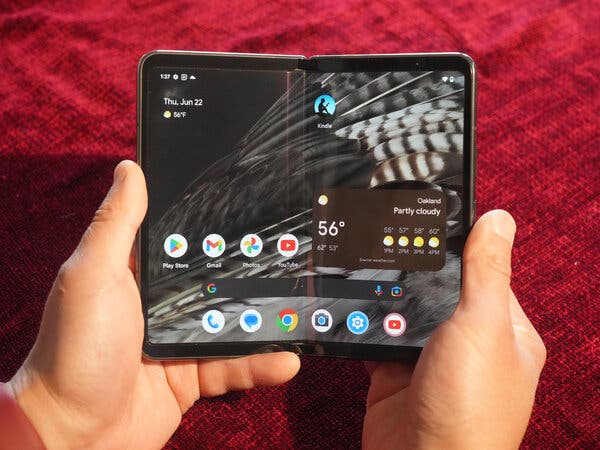
Most modern mobile development isn’t happening in a vacuum. A huge chunk of the apps we use are built using cross-platform frameworks like React Native, Flutter, or shared design systems. Even when apps are built natively (Swift for iOS, Kotlin for Android), the design teams usually work in tandem.
If a product manager at Spotify, Instagram, or Strava has to authorize a UI redesign to accommodate an Apple foldable, they aren’t going to design a completely different logic for Android. They are going to design a “responsive mobile view” that works on variable screen sizes.
Once that logic exists—once the designers have figured out how the news feed should flow when the screen width doubles—porting that behavior to the Android version is significantly cheaper than inventing it from scratch. We need Apple to create the business case for responsive mobile design so we can reap the benefits.
The Identity Crisis: Tablet or Phone?
One of the biggest struggles I have with my current foldable is the identity crisis. Is it a phone? Is it a tablet? Android treats it as a weird hybrid. Some apps trigger “tablet mode” (like Gmail), while others stubbornly stay in “phone mode” (like Instagram, often).
I am watching closely to see how the industry handles this distinction in 2026. If the rumored Apple device runs iPadOS on the inner screen, that sets a very high bar. iPad apps are, generally speaking, far superior to Android tablet apps. They utilize the space better. They support keyboard shortcuts better. They feel like desktop-class software.
If the competition treats their foldable as a tablet first, it forces Samsung, Google, and OnePlus to ensure their devices can compete on that level. Right now, I feel like Samsung is happy if the app just opens without crashing. The bar is too low.
However, there is a risk. If Apple’s device is just a “tall iPhone” that folds, and the inner screen just runs big iOS apps, then we are in trouble. That validates the lazy approach. But knowing Apple’s obsession with differentiating product lines, I doubt they will cannibalize the iPad mini market without offering a distinct software advantage.
A Look at the Current Landscape (Late 2025)
Let’s look at where we stand right now with Android News regarding foldables. I’ve been testing the latest foldables from three major manufacturers this month. The hardware convergence is real. They are all thin, they all have great cameras, and they all have bright screens.
But the software fragmentation is getting annoying. Samsung has its taskbar and multi-window gestures. OnePlus has “Open Canvas,” which I actually prefer because it allows you to shove apps off-screen virtually. Google has its own dock implementation.
Because every manufacturer handles multitasking differently, third-party developers don’t hook into these features natively. They rely on the OS to force-resize their apps. This often results in weird glitches. I was playing a strategy game last week on my commute, and every time I received a notification that popped up over the game, the aspect ratio glitched and I had to restart the app.

This is the kind of friction that keeps “normals” away from foldables. Tech enthusiasts like me put up with it because we love the bleeding edge. My brother? He returned his foldable after three days because “TikTok looked weird.” That is the metric that matters.
The Developer’s Perspective
I dabble in Android development, so I decided to open up Android Studio and see how hard it actually is to support these screens. The tools are there. Jetpack Compose makes it relatively easy to build adaptive layouts. You can say, “If width is greater than 600dp, show two columns.”
The problem isn’t difficulty; it’s priority. If I have a backlog of 50 bugs and features, and my boss tells me to prioritize them, “Support for the 2% of users with folding screens” goes to the bottom of the list. It sits below “Dark Mode fixes” and “New icon design.”
This changes the moment a major competitor enters the ring. If 20% of the premium market shifts to foldables because of a new entrant, suddenly that ticket moves from the bottom of the backlog to the top. It becomes a P0 priority. That is the shift I am waiting for.
Why Android Still Wins in the End
You might think I’m down on Android. I’m not. I think Android handles file management, background processes, and customization infinitely better than the competition. I can run a torrent client, a file manager, and a terminal emulator on my Z Fold 7 simultaneously. I doubt any device running a competitor’s OS will ever allow that level of freedom.
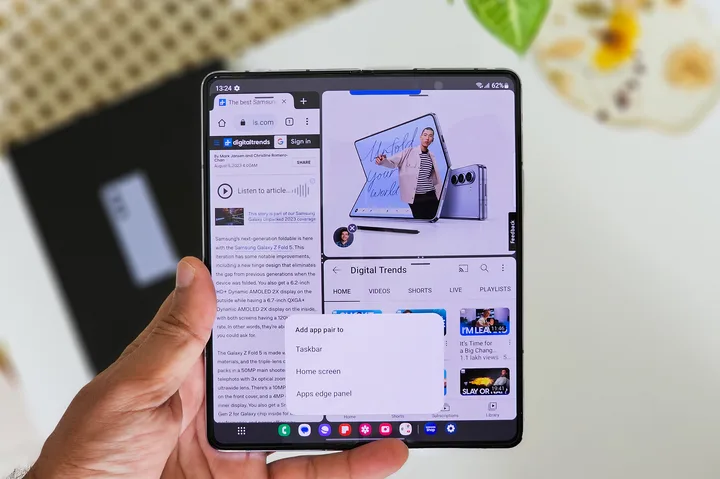
But I want the best of both worlds. I want the freedom of Android with the polish of an ecosystem that forces developers to care. I want my banking app to use the full screen. I want my video editor to have a dedicated timeline view when unfolded. I want the “tablet” part of my foldable to actually feel like a tablet.
Currently, Android foldables are amazing hardware searching for software that deserves them. We have been waiting for the “Year of the Android Tablet” since 2011. It never really happened. But the “Year of the Foldable” is arguably already here in terms of hardware maturity. We just need that final push to get the software over the finish line.
What to Watch for in 2026
As we head into the new year, I am keeping my eyes on a few specific indicators. First, watch the cross-platform frameworks. If Flutter and React Native release major updates focused on “foldable primitives” or “hinge-aware layouts” in Q1 2026, that is a smoking gun that big changes are coming.
Second, watch the acquisitions. If major tech companies start buying up studios that specialize in tablet-first productivity apps, they are gearing up for a war over screen real estate.
I love my Android foldable. I wrote this entire article on it while sitting at a coffee shop, using a split-screen setup with my research on one side and my editor on the other. It works. But it could be so much better. And ironically, the thing that might finally perfect the Android experience is the one thing Android fans usually hate: competition from Cupertino.
So, bring it on. Let’s see what they have. Because if they raise the bar, Android developers will clear it, and we’ll be the ones reaping the rewards on our superior hardware.