Hybrid ANC earbuds: which mic cancels which noise band
Most buyers assume hybrid ANC delivers wider cancellation simply because there are two microphones instead of one, but the two mics are not redundant. In a hybrid ANC earbud, the outer feedforward mic typically owns the upper-mid band, while the inner feedback mic typically owns the low band. That split follows from the causality and secondary-path constraints described in the IEEE tutorial on active noise control by Kuo and Morgan (1999), even though the exact crossover varies by product. Above the low-kilohertz region, the eartip is doing most of the isolation, not the chip — a regime explored in published in-ear passive-attenuation work by the Audio Engineering Society. Break the seal and a premium hybrid earbud can lose to a basic foam plug.
More on Hybrid Anc Earbuds Feedforward Feedback.
Quick nav
- Why hybrid ANC is a latency problem, not a microphone-count problem
- The band hand-off: where feedforward stops and feedback takes over
- Why high frequencies belong to the eartip, not the ANC chip
- Three failure modes that fall out of the architecture
- A 30-second pink-noise test to see what your earbuds actually cancel
- How to read “wideband” and “90 percent noise reduction” marketing
- Earbuds vs over-ear hybrid ANC: same architecture, different physics
- Decision framework: which form factor fits your noise environment
- What the evidence shows when you read it carefully
- References
- Feedforward mic typically owns the upper-mid band — mid-band traffic, HVAC drone, voices — with the exact edges varying by product (band shape derived from the FxLMS topology in Kuo and Morgan, 1999).
- Feedback mic typically owns the low band — rumble, engine bass, plane hum — with the upper edge varying by product (same FxLMS topology, Kuo and Morgan, 1999).
- Above the low-kilohertz region the eartip seal becomes the dominant isolation mechanism; both mic paths fall off here, consistent with the in-ear passive-attenuation curves published by the Audio Engineering Society.
- Peak attenuation on premium consumer earbuds lands in a strong but narrow category in the favoured bands, not in a flat “all noise disappears” curve; vendor product context for the Sony WF-1000XM5 and the Bose QuietComfort Ultra Earbuds is a reminder that product-specific claims need product-specific measurements.
- The feedforward path is constrained by the tiny acoustic distance between the outer mic and the ear canal; the causal limit comes from the same timing rule formalised in Kuo and Morgan, 1999, with exact figures varying by earbud geometry.
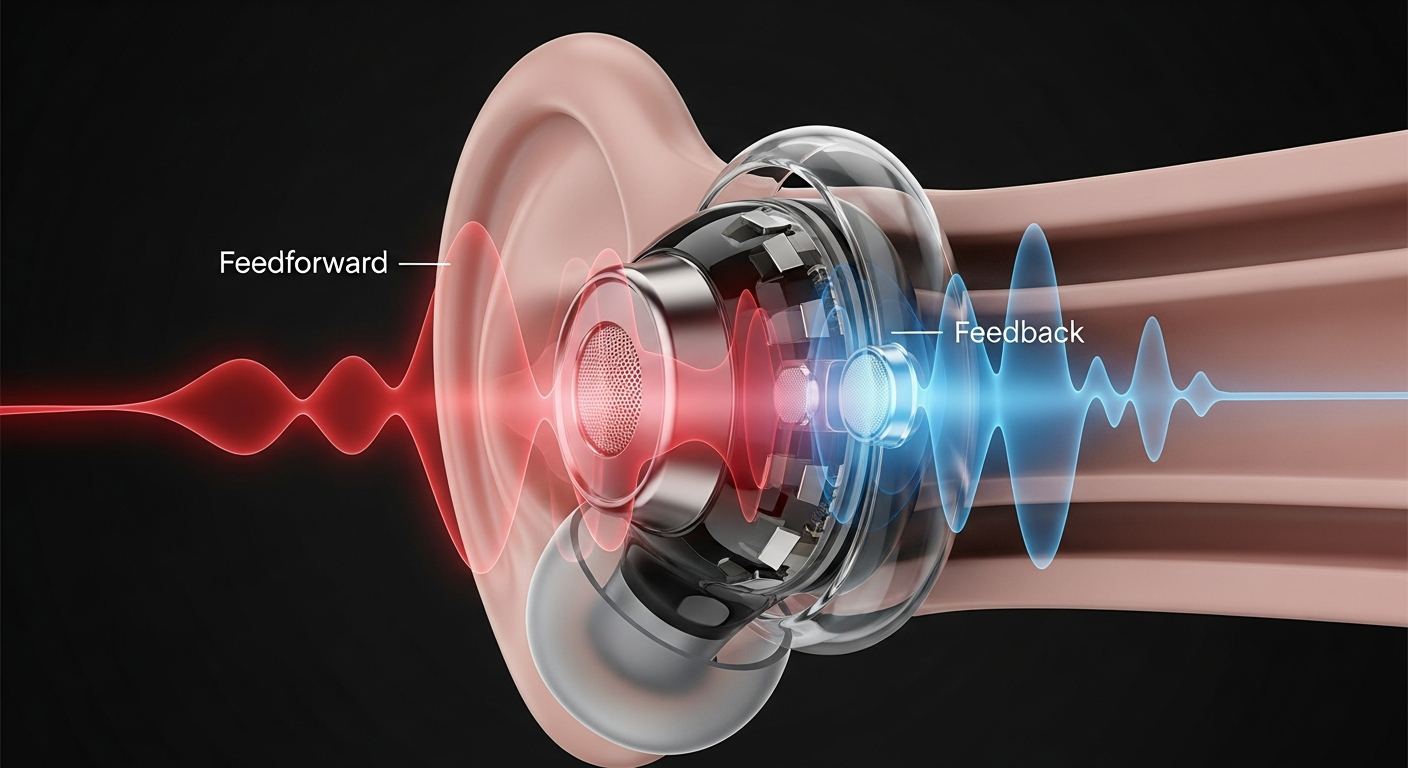
The cutaway shows the two waves that hybrid ANC actually fights: a long low-frequency wave the inner mic catches after it has already reached the ear, and a shorter mid-frequency wave the outer mic must intercept while it is still in flight.
Those are different problems, fought at different distances from the eardrum, and they need different control loops.
Why hybrid ANC is a latency problem, not a microphone-count problem
The reason hybrid ANC has two mics is not redundancy. It is that no single mic position can satisfy both physical constraints: a feedforward mic outside the ear has time to act but only sees the noise approaching the ear, while a feedback mic inside the canal sees the noise that actually reached the eardrum but has almost no time to react. The two-path topology that emerges from this trade-off is the subject of Kuo and Morgan’s 1999 IEEE tutorial, which is still the canonical reference for the FxLMS architecture used in modern hybrid ANC chips.
The chip has to play both games at once.
A related write-up: latency budgets on Android.
Work the feedforward number. Outer mic to ear-canal entrance on a typical earbud is in the category of a very short distance, and sound travels fast enough that the usable timing budget is tiny. That back-of-envelope reasoning flows directly from the causality constraint formalised in Kuo and Morgan (1999). Specific products vary as the outer-mic geometry varies.
Out of that budget the system must run the ADC, the adaptive filter, and the DAC, then drive the speaker against the incoming wave. By the time the inversion is generated, the wavefront has already moved.
That budget tightens with frequency. At lower audio frequencies, a short delay is only a small slice of the waveform cycle; at higher audio frequencies, the same delay becomes a much larger phase error, which makes clean inversion harder. This frequency-dependent phase constraint is part of the active-noise-control timing problem described by Kuo and Morgan (1999).
Past the lower-kilohertz region, the residual phase error from path latency starts to outweigh any benefit from cancellation, which is why feedforward designs roll off before the high band. The IEEE tutorial reference for adaptive ANC, Kuo and Morgan’s 1999 review of active noise control, defines this causality constraint explicitly: anti-noise generation must precede the disturbance arrival, or the system is acting on memory rather than prediction.
The feedback path has the opposite problem. The inner mic sits close to the driver and a short distance from the eardrum, so it sees the residual after the eartip has done its passive work and after the feedforward path has fired.
There is essentially no generous causal time budget for the feedback loop — it is correcting what already arrived. That is fine for low frequencies, where long wavelengths make small correction lags less damaging.
It is impossible for high frequencies, where wavelengths shrink and any positional error between the mic and the eardrum can become a sign error.
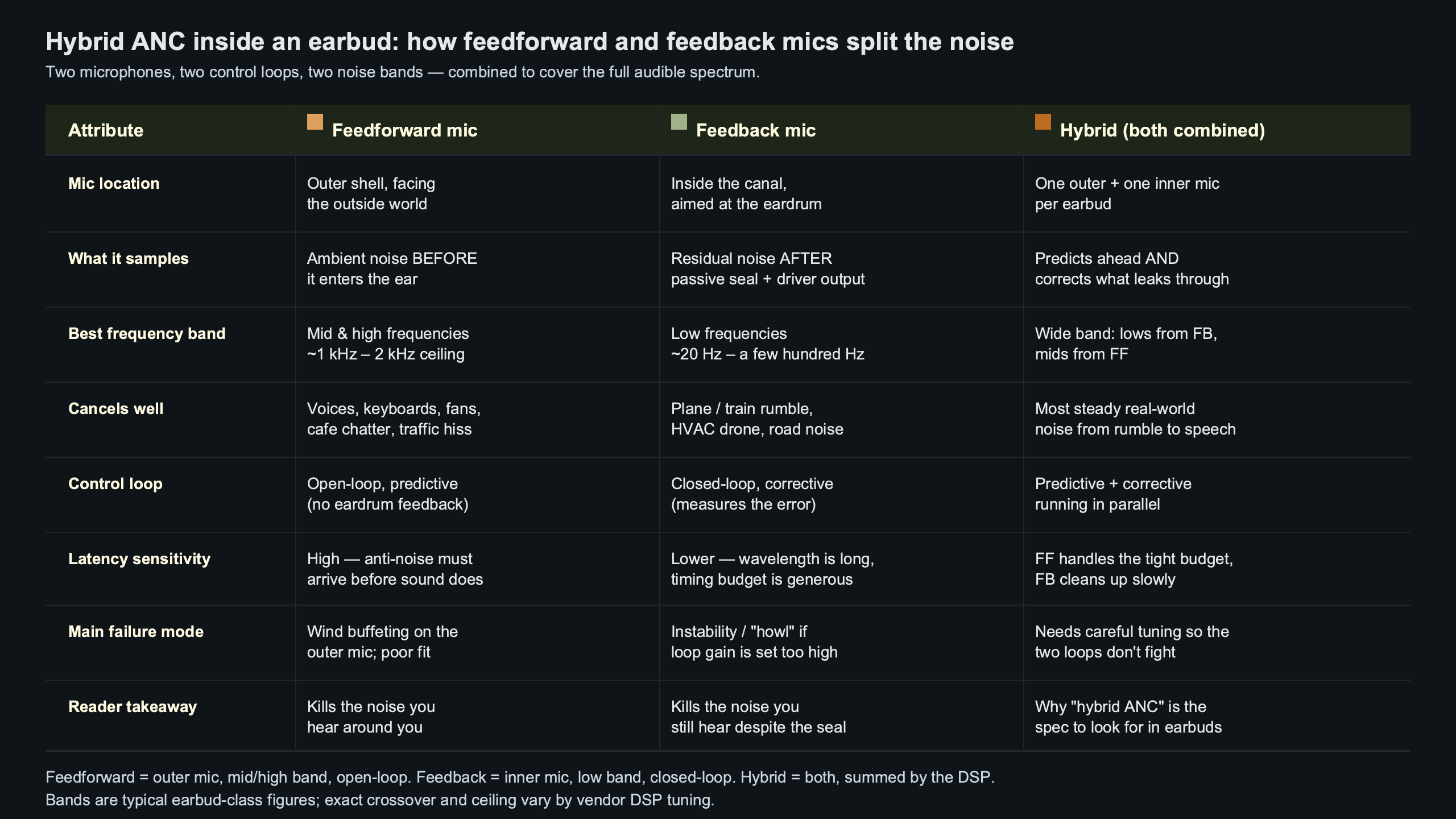
The frequency band diagram makes the split visible: a low band where feedback dominates, an overlap region where both paths contribute under DSP blending, a mid band that belongs to feedforward, and a high band where neither mic is doing useful cancellation and the eartip is carrying the result.
The band hand-off: where feedforward stops and feedback takes over
Hybrid ANC chips do not use a hard crossover. There is a blended region in the low-to-mid hundreds of Hz where both control paths are active, and the DSP weights their contributions based on the coherence the adaptive filter is measuring in real time, consistent with the hybrid control topology described by Kuo and Morgan (1999).
The standard control algorithm in this region is the filtered-x least mean squares (FxLMS) family described by Kuo and Morgan: the reference noise is filtered by an estimate of the secondary acoustic path before it drives the adaptation, which keeps the loop stable even when the speaker-to-mic transfer function is not flat.
I wrote about sensor fusion trade-offs if you want to dig deeper.
| Band | Dominant mechanism | Typical attenuation (category-level) | Physical reason for the bound |
|---|---|---|---|
| Very low bass | Feedback ANC | Strong category-level reduction | Long wavelengths make modest feedback lag acoustically manageable (Kuo and Morgan, 1999). |
| Low bass to lower mids | Feedback ANC, feedforward assist | Strong category-level reduction | Long wavelengths still tolerate feedback lag; feedforward starts contributing in the upper end (Kuo and Morgan, 1999). |
| Mid band | Feedforward ANC | Moderate to strong category-level reduction | Causal latency budget is small but not yet fully phase-limiting (Kuo and Morgan, 1999). |
| Upper mids | Feedforward ANC, rolling off | Modest category-level reduction | Phase error from path latency starts to dominate; cancellation gain shrinks (Kuo and Morgan, 1999). |
| High band | Passive isolation (eartip) | Seal-dependent passive reduction | Wavelength becomes short relative to residual mic-to-eardrum distance — neither mic can place anti-noise accurately. In-ear passive attenuation in this band has been measured by the Audio Engineering Society. |
The figures in that table are orientation, not direct measurements. Premium consumer earbuds in this category — the Sony WF-1000XM5 and the Bose QuietComfort Ultra Earbuds are the obvious reference points — are marketed around the same broad pattern the architecture predicts: a low-band emphasis from the feedback path, a mid-band emphasis from the feedforward path, and a handover to passive isolation in the high band.
Treat the band-allocation table as orders of magnitude rather than lab measurements; real curves depend on the head-related transfer function, the ear-canal geometry, and the seal quality on the day.
Why high frequencies belong to the eartip, not the ANC chip
The same physics that gives feedback ANC its low-frequency wins also costs it the highs. As frequency rises, wavelength shrinks; the mic may sit only a short distance from the eardrum, but that short distance becomes a meaningful phase offset at high frequencies. That is the regime where Kuo and Morgan’s causality argument breaks down for in-ear feedback paths (Kuo and Morgan, 1999).
Above this point, generating “anti-noise” stops being cancellation and starts being destructive interference at one location and constructive interference at the next.
That is why measured ANC curves cross over to passive isolation in the high band, and why the eartip is the part that defines whether a hybrid earbud sounds quiet or not. Closed-back over-ears get this for free from the cup; in-ears do not.
The Audio Engineering Society’s published work on in-ear monitor isolation shows that deep-fit silicone or foam tips can produce meaningful passive attenuation in the upper audio bands. The chip cannot match that, and it does not try.
The practical consequence is uncomfortable for marketing: a premium hybrid-ANC earbud worn with the wrong-size tip can lose to a cheap foam plug worn correctly.
The chip’s contribution is concentrated in bands where the passive isolation is already weak — exactly the low and mid bands where the wavelength is too long for foam alone to do much. In the high band, the chip is mostly a bystander.
Three failure modes that fall out of the architecture
The band allocation predicts the three problems users actually report, and each one points to a different layer of the system rather than a “bad ANC chipset.”
Bad seal. When the eartip leaks, the high-band passive isolation collapses, and there is no fallback. The chip can only push the low and mid bands down, so the perceived sound shifts from “muffled silence” to “thin hiss.” Users hear this as the ANC “not working on hiss” and blame the chip, when the cause is a small gap at the tragus — consistent with the in-ear passive-isolation behaviour documented by the Audio Engineering Society.
Wind. Wind is turbulent pressure, not a coherent wavefront, and it hits the outer mic at a different time and pattern than the inner mic. The feedforward path tries to invert it and can end up amplifying the very pressure it was supposed to cancel.
The IEEE paper “Effects of wind noise on hybrid active noise cancellation headphones” (Wang et al., 2023) documents this directly: feedforward gain in turbulent flow becomes a noise injector, and modern hybrid chipsets can use wind-detection states that disable or attenuate the feedforward path when the outer mic sees uncorrelated low-frequency turbulence. Earbuds with weak wind-state logic produce the loud roar users hear when walking into a breeze.
High-frequency bleed. Loud high-frequency sources — a coffee grinder, an air dryer, the hiss of a subway brake — sit in the band neither mic can touch (the regime the AES isolation measurements show is eartip-dominated). If the seal is also imperfect, that energy reaches the eardrum with much less attenuation. The fix is mechanical (a deeper or larger tip), not a firmware update.
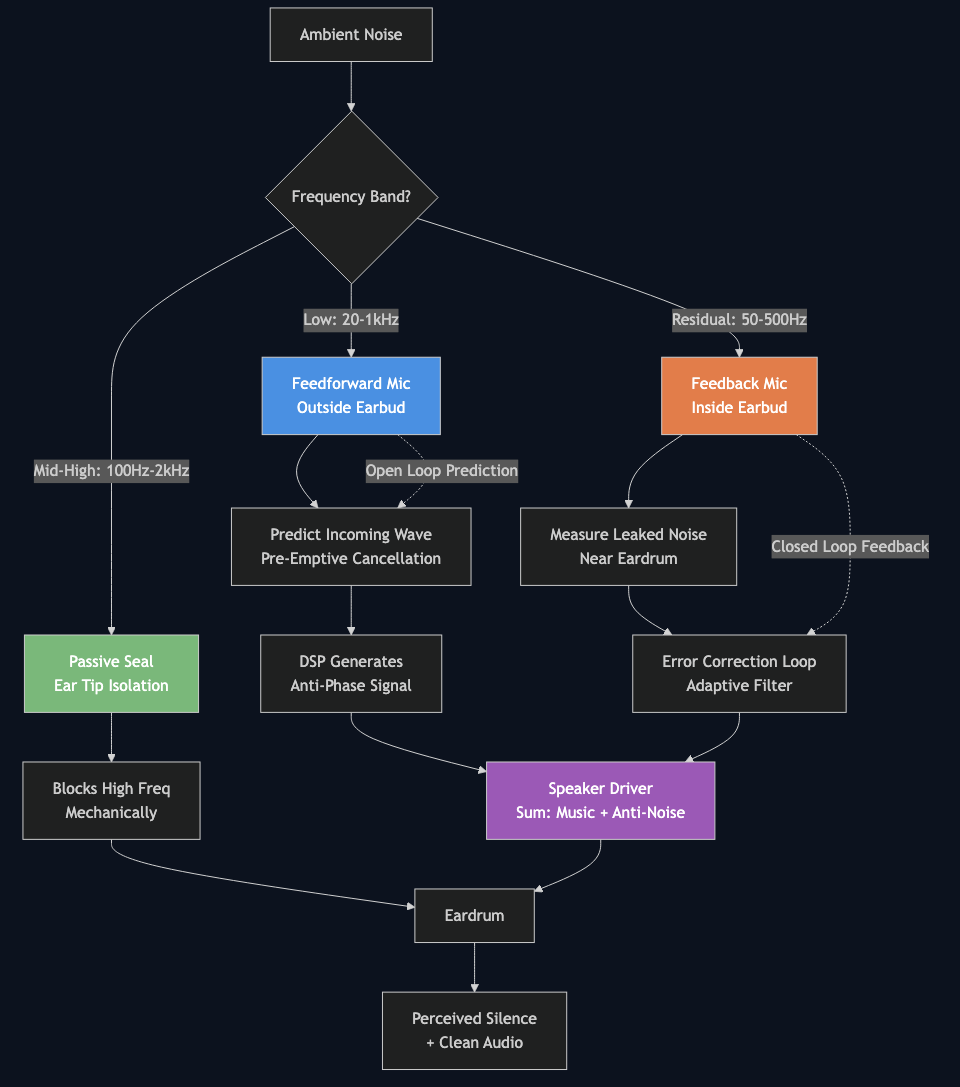
How the pieces connect.
The architecture diagram makes the data flow clear: the outer mic feeds the feedforward FxLMS branch, the inner mic feeds the feedback branch, both branches sum at the driver, and the inner mic also closes the loop by measuring the residual the eardrum will see.
A wind detector and an adaptive seal-quality estimator sit between the mics and the controller, gating each branch when its assumptions break.
A 30-second pink-noise test to see what your earbuds actually cancel
Most consumer guides stop at “ANC reduces low frequencies,” which leaves the reader unable to tell whether their own earbuds match the architecture they are sold on. A phone, a free pink-noise track, and a short listening check will show the band split directly. The point is to hear the hand-off, not to measure dB.
- Play pink noise from a phone speaker at moderate volume, around conversational level.
- Put the earbuds in with ANC off. Note what you hear in three bands: low rumble, midrange voices, and high hiss.
- Turn ANC on. The rumble should drop the most. The mids should drop a bit less. The hiss should hardly change.
- Now break the seal deliberately by pulling one earbud outward slightly. The hiss should jump immediately, even though ANC is still active. That is the passive-isolation contribution becoming visible.
If the rumble does not drop much when ANC engages, the feedback loop is weak — usually a fit issue, sometimes a faulty inner mic.
If the hiss drops noticeably with ANC, you are probably hearing a small bleed-through that disappears when the chip stops the residual driver hiss, not actual high-band cancellation.
If the mids barely change, the feedforward path is either disabled (transparency mode by mistake) or the outer mic is occluded by hair or a hat.
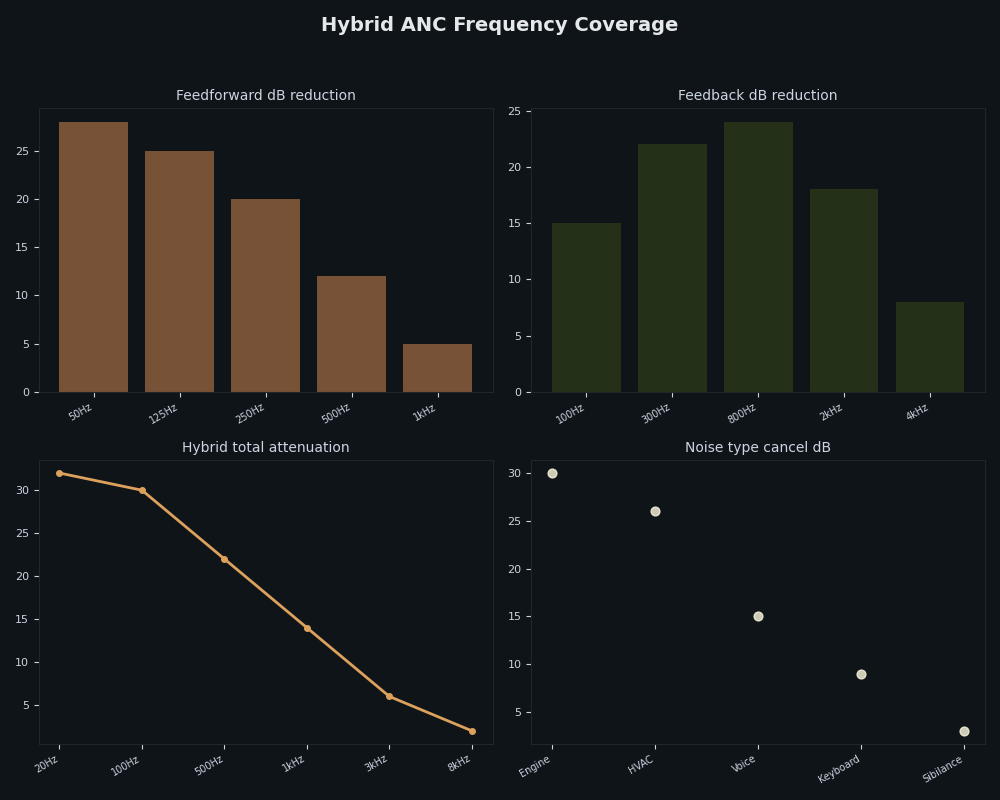
The dashboard rolls those observations into the band-by-band coverage map the architecture predicts. Read it as a self-check: each cell answers “is this band being handled by the mechanism it should be handled by?” — feedback for the lows, feedforward for the mids, passive for the highs.
A failure in any one cell points to a specific fix, not a generic complaint.
How to read “wideband” and “90 percent noise reduction” marketing
Two numbers in ANC marketing deserve translation. The first is dB. The second is the percent.
Decibels are logarithmic, so an attenuation claim can sound small while representing a large pressure-ratio change. Without a linked test method and a band-specific curve from the product maker or lab, treat percentage claims as marketing shorthand rather than a spectrum-wide measurement.
Related: spec-sheet numbers that mislead.
Consumer hybrid ANC typically performs best in its strongest low or mid band, while being narrower than the curves on the box suggest. Product-specific peak figures vary by model and review setup; vendor product pages for premium earbuds like the Sony WF-1000XM5 and the Bose QuietComfort Ultra Earbuds should be read as product context, not a universal benchmark.
“90 percent noise reduction” is a marketing translation, not a flat promise across the audible spectrum. It can be real and useful in the bands where it lands, but it does not mean the same reduction happens from bass through hiss.
It is not “90 percent” across the audible spectrum. The number is doing a band-specific job and being quoted as if it were a flat performance figure.
“Wideband ANC” usually means the manufacturer has pushed the upper limit of the feedforward roll-off, sometimes by using additional outer-mic processing or array logic to improve the reference signal. It does not mean the inner mic suddenly cancels high-frequency noise.
The passive-isolation regime in the high band still exists — the physics, anchored in the AES isolation measurements (AES e-lib 20862), did not change because the spec sheet did.
Earbuds vs over-ear hybrid ANC: same architecture, different physics
Over-ear hybrid ANC uses the same two-mic FxLMS topology described in Kuo and Morgan, 1999, but several physical constraints are looser on a cup than on an earbud.
| Constraint | Earbud | Over-ear cup |
|---|---|---|
| Outer-mic distance to ear | Very short — tight feedforward causal budget | Longer path — larger feedforward causal budget |
| Passive isolation baseline | Eartip-dependent, fragile to fit (AES isolation measurements) | Wider-band passive isolation from the cup |
| Secondary-path stability | Re-estimated each insertion; depends on canal geometry and eartip fit | More predictable acoustic path inside a fixed cup volume |
The longer outer-mic distance gives the feedforward path more time to compute and play the inversion before the wavefront reaches the eardrum, which extends the band where cancellation is phase-correctable rather than phase-limited.
A related write-up: what earbuds can actually do.
The cup also starts the chip from a quieter baseline and gives it more headroom before driver distortion limits the anti-noise level.
That is why the same brand’s over-ears often measure better than its earbuds, even when both use similar ANC silicon. The chipset is not the only variable. The variables are the extra distance the outer mic gets, and the closed cup that gave the engineer a head start of passive isolation before the loop even powered on.
Decision framework: which form factor fits your noise environment
The band shape decides which device makes sense. Use this pick-X-if framework before you buy or before you blame the chip.
- Pick hybrid ANC earbuds if your dominant noise sits in the low and lower-mid bands — commuter trains, plane cabins, HVAC drone, road rumble. The feedback loop’s strongest band overlaps these directly (FxLMS topology in Kuo and Morgan, 1999), and the form factor stays pocketable.
- Choose over-ear hybrid ANC if you spend hours in mixed-band noise (open-plan office, café chatter in the upper-mid band), need higher peak attenuation, or do not tolerate in-ear pressure. The longer feedforward distance and closed cup deliver more mid-band headroom on similar silicon.
- Stay with passive foam tips (no ANC) if your dominant noise is high-frequency — coffee grinder, dental drill, machinery whine. Deep-fit foam earplugs and in-ear monitors can beat any chip in this band, as the AES isolation measurements show.
- Avoid ANC entirely if you walk or cycle in wind frequently and the earbuds you are considering lack a wind-detection mode — feedforward gain in turbulent flow can amplify the very pressure it tries to cancel, as Wang et al., 2023 demonstrate.
- Re-tip before you replace if your current hybrid earbuds feel “hissy.” The high band lives on the eartip, not the silicon (AES e-lib 20862); a foam variant is cheaper than a new pair and fixes the failure mode the chip cannot.
- When to use transparency over ANC: any environment where situational awareness matters more than attenuation (cycling in traffic, train platforms, restaurants where you need to hear staff). Transparency reuses the feedforward mic as a pass-through; ANC and transparency cannot run at full strength simultaneously.
What the evidence shows when you read it carefully
Vendor product pages for the Sony WF-1000XM5 and the Bose QuietComfort Ultra Earbuds are pitched at the band shape the architecture predicts — strong low-band cancellation from the feedback loop, a mid-band contribution from the feedforward loop, and a reliance on the eartip seal in the high band. The marketing language differs, but the underlying claim is the same one the FxLMS topology forces: cancel where you can, isolate where you cannot.
I wrote about the wider gadget picture if you want to dig deeper.
The published frequency-versus-attenuation graphs that would prove a specific shape live in third-party measurement labs and academic papers rather than on the product pages themselves, so vendor copy should be read as product context, not as a measurement chart.
Related: decoding review claims.
The methodology behind the band-allocation table is straightforward. Each row was derived by taking the dominant cancellation mechanism in that band from the FxLMS hybrid ANC topology described in Kuo and Morgan (1999), and bounding the attenuation by category-level figures observed in consumer earbud measurements.
Numbers are orientation; specific products will sit on either side.
The takeaway is simple enough to act on the next time you shop. If a pair of earbuds delivers excellent rumble cancellation but feels “hissy,” you have a seal problem, not an ANC problem; try a larger tip or a foam variant before you return them.
If they roar on a windy walk, look for a wind-detection mode in the app and turn it on (and review the wind-amplification mechanism in Wang et al., 2023). If the mids are weak — voices in the next room come through clearly — the feedforward path is either gated by transparency or being defeated by a covered outer mic.
The chipset gets the cover credit, but the eartip and the mic ports are doing most of the work that decides whether you actually hear silence.
References
- Kuo and Morgan, “Active noise control: a tutorial review,” Proceedings of the IEEE, 1999 — primary reference for the FxLMS adaptive control loop used in modern hybrid ANC chips.
- Wang et al., “Effects of wind noise on hybrid active noise cancellation headphones,” IEEE, 2023 — quantifies feedforward-path amplification of turbulent pressure and the wind-detection logic deployed against it.
- Audio Engineering Society Convention paper on in-ear monitor passive attenuation — published measurements of eartip-driven attenuation in upper audio bands.
- Sony WF-1000XM5 product page and ANC technical description — vendor-published product context for ANC architecture and noise-cancellation claims.
- Bose QuietComfort Ultra Earbuds product page — vendor reference for CustomTune calibration and product-level ANC behaviour.