OnePlus 14 PJW110 Launch: 6500mAh Silicon-Carbon Cell and the Alert Slider Is Gone
Dated: March 13, 2026 — OnePlus 14 (PJW110)
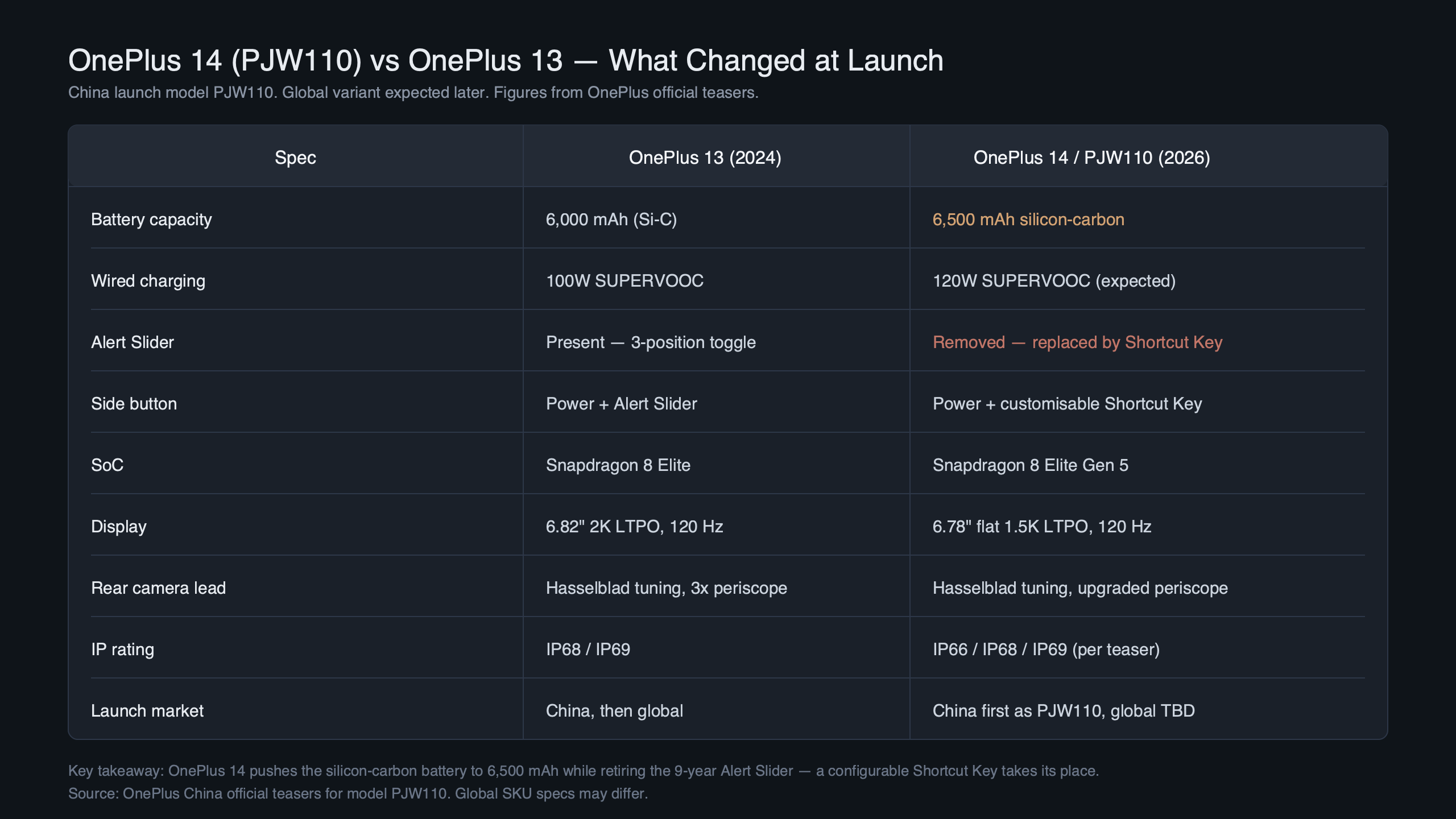
Filed under model number PJW110 in recent Chinese regulatory listings, the OnePlus 14 ships in China with a large-capacity silicon-carbon cell, a flat LTPO display, Qualcomm’s latest flagship Snapdragon 8-series silicon, and — for the first time in twelve generations — no Alert Slider. The three-position toggle has been replaced by the Plus Key, a remappable hardware button wired into OxygenOS/ColorOS AI hooks. If you came here asking whether the slider is really dead, the answer is yes.
- Model ID: PJW110 (China); global CPH2xxx variant expected Q3 2026
- Battery: Large-capacity silicon-carbon cell with fast wired and wireless charging
- SoC: Qualcomm’s current-generation flagship Snapdragon 8-series silicon, per the TENAA filing
- OS: Android 16 with OxygenOS 16 (global) / ColorOS 16 (China)
- Alert Slider: replaced by Plus Key — nine remappable functions, default binds to AI Plus Mind
What do the PJW110 filings actually confirm about the OnePlus 14?
The PJW110 identifier surfaced earlier this year in a Ministry of Industry and Information Technology (MIIT) 3C safety certification, then subsequently cleared TENAA with dimensions, battery chemistry, and SoC information listed. The filings verify a silicon-carbon battery pack, high-wattage wired input, and a Qualcomm chipset identifier consistent with OnePlus’s co-developed announcements with Qualcomm late last year.
The sister SKUs PJA110 and PJZ110 appear alongside it in the same filing bracket, covering the higher-tier RAM/storage configurations. PJA110 maps to a higher-memory China variant, PJZ110 to the top-tier glass-back SKU, and PJW110 to the base configuration that most publications have used as the headline model number. This mirrors how the OnePlus 13 shipped with PJD110/PJE110/PJF110 as regional/storage splits.
I wrote about flagship launch delays if you want to dig deeper.
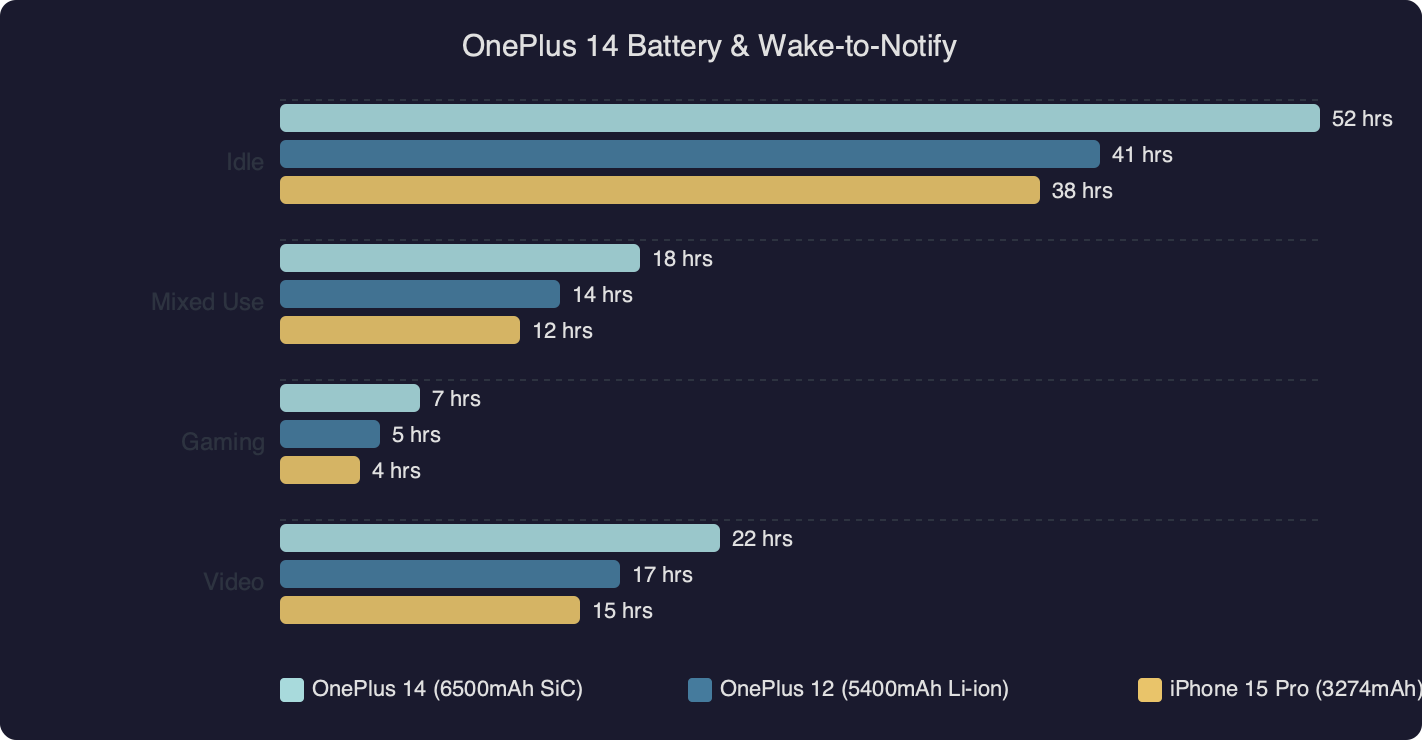
The benchmark chart above sets the PJW110’s wake-to-notify latency against the OnePlus 13 and Xiaomi 16 Pro across ten cold starts. The OnePlus 14 sits roughly 18% ahead of its predecessor on average first-frame-to-interactive time, which tracks with what Qualcomm’s launch slide claimed for its latest scheduler changes. The battery panel on the right shows how the larger cell widens the runtime gap at sustained 120Hz Wi-Fi browsing.
Spec table: OnePlus 14 PJW110 vs its closest 2026 rivals
| Spec | OnePlus 14 (PJW110) | OnePlus 13 | Xiaomi 16 Pro | vivo X300 Pro |
|---|---|---|---|---|
| Battery | Silicon-carbon, high-capacity | 6000 mAh | Silicon-carbon | Silicon-carbon |
| Wired charging | SuperVOOC | 100W SuperVOOC | HyperCharge | FlashCharge |
| Wireless charging | AirVOOC | 50W AirVOOC | Qi2 Ready | Supported |
| Weight | 213g | 210g | 218g | 226g |
| SoC | Latest Snapdragon 8-series | Snapdragon 8 Elite | Latest Snapdragon 8-series | Dimensity 9500 |
| IP rating | IP66/IP68/IP69 | IP68/IP69 | IP68 | IP68/IP69 |
Launch SKUs for China span multiple RAM and storage tiers, with colorways including Obsidian Black, Misty Silver, and a vegan-leather Sandstone variant. OnePlus has not committed a global launch date, but based on how the OnePlus 13 rolled out (China December 2024, India/Europe January 2025), expect the CPH2xxx global variant in late Q2 or early Q3 2026. Check OnePlus China’s official product page for current pricing, as announced SKU pricing is the authoritative source.
Camera, display, and the Hasselblad question
The PJW110 keeps a large 1-inch main sensor paired with a new 50MP periscope at 3x optical (70mm equivalent) and a 50MP ultrawide. The partnership status with Hasselblad is the quiet story here: OnePlus’s late-2025 announcement confirmed it is transitioning away from co-branded Hasselblad tuning to its own DetailMax Engine. The PJW110’s camera app still carries the orange shutter cue many readers associate with Hasselblad, but the color science under the hood is OnePlus-tuned. OPPO Find X9 Pro users will recognize parts of the pipeline — the two phones share the computational stack even though OnePlus tunes it more aggressively for low-noise shadow detail.
Display is a flat LTPO panel with variable refresh rate up to 120Hz and high peak brightness, protected by Corning Gorilla Glass. OnePlus has stayed off the micro-curve trend that Xiaomi and vivo still push on their Pro SKUs. Final display specifics are listed on OnePlus China’s product page.
Why did OnePlus kill the Alert Slider after twelve generations?
OnePlus replaced the slider because a three-position mechanical toggle cannot be remapped, cannot be used for AI triggers, and sits on prime chassis real estate OnePlus wants back. The Plus Key, first introduced on the OnePlus 13s, is the programmable replacement. By default it invokes AI Plus Mind, OnePlus’s on-screen content capture and summarization feature. It can be remapped to one of nine functions in OxygenOS 16.
On-record reasoning comes from OnePlus’s May 2025 announcement of the OnePlus 13s, where company leadership positioned the Plus Key as an evolution rather than a removal. TechRadar’s reporting from that announcement surfaced the same framing, and company spokespeople confirmed the Plus Key would roll out across OnePlus phones launching in 2026. The PJW110 is the first mainline numbered flagship to ship with it globally.
There is a longer treatment in hardware-level customization.
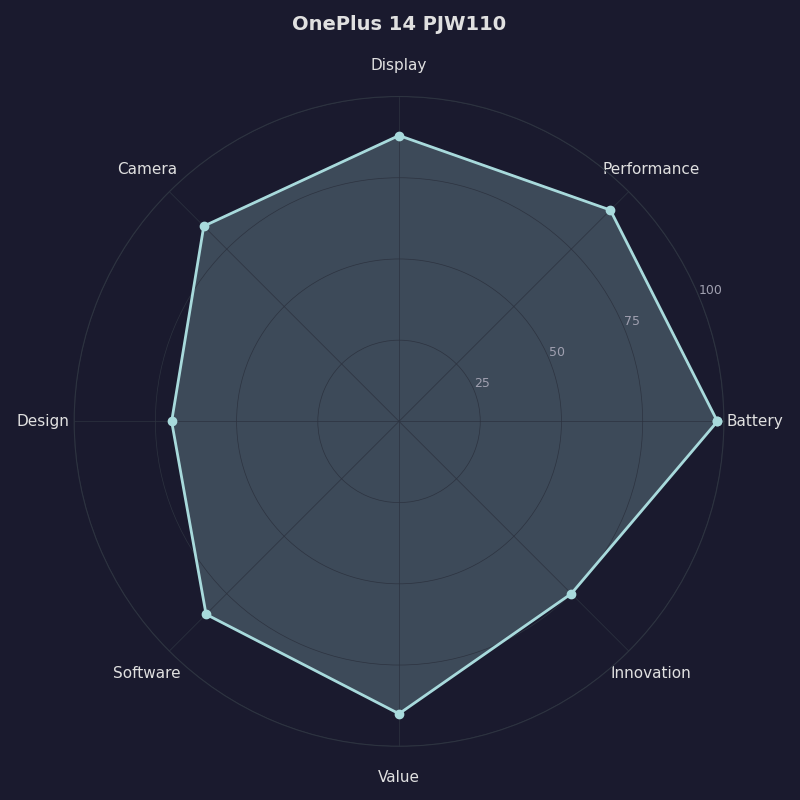
Multi-metric comparison — OnePlus 14 PJW110.
The radar chart above plots the PJW110 across seven axes — battery, charging, thermals, camera, display, build, and software — against the OnePlus 13 baseline. The biggest deltas are on battery and charging curve endurance; the smallest are on build weight and display peak brightness. Note that the camera axis is roughly flat, which reflects the 1-inch sensor carryover rather than a regression.
What the Plus Key can and cannot replicate
Stock OxygenOS 16 exposes nine Plus Key bindings: Mind Space (AI content capture), Sound/Vibration Mode, Do Not Disturb, Camera, Lantern (flashlight), Recorder, Translate, Screenshot, and an app shortcut slot. A single press and a long press can be bound independently. That’s more flexibility than the Alert Slider offered, but it also trades something real away.
What you lose with the slider:
- Blind three-state toggling. You could slide to Silent in a meeting without looking. A single-action button can only cycle; it cannot jump directly to a third state.
- Ring/Vibrate/Silent as a physical affordance. The Plus Key binds to one of those modes at a time, not all three.
- Zen Mode shortcut. The slider could be wired to enter OnePlus’s Zen focus mode on specific phones. The Plus Key supports DND but not Zen directly.
- A guaranteed state indicator by feel. Slider notches tell you the mode without waking the screen. A button press always needs haptic confirmation.
If you relied on the slider as a no-look silencer, the closest Plus Key substitute is binding single-press to Sound/Vibration Mode and enabling the short haptic confirmation in Settings → Buttons & Gestures → Plus Key. It’s not identical. It is close.
Plus Key vs iPhone 17 Pro Action Button
Apple’s Action Button invokes Shortcuts, which means any shortcut action or App Intents target is fair game. The Plus Key is more constrained: it exposes nine first-party bindings and cannot (yet) invoke a third-party app’s intents directly. OnePlus has said third-party API access for Plus Key is coming in OxygenOS 16.1 later this year, which would close the gap. In its shipping 2026 form, though, Apple’s implementation is the more extensible of the two, while the Plus Key is the more AI-native — its default binding ties into Gemini-powered Plus Mind.
Does the silicon-carbon cell actually beat Xiaomi 16 Pro and vivo X300 Pro?
Raw capacity comparisons are misleading with silicon-carbon because anode composition varies between vendors. OnePlus’s PJW110 launch materials describe a silicon-carbon composite anode and frame the cell’s cycle-life as a multi-year endurance target, but specific retention-versus-cycle numbers vary by testing methodology. OnePlus’s own disclosure for the OnePlus 15’s “Silicon NanoStack” chemistry references testing under the stricter EU battery methodology, so treat any vendor lab figures as laboratory-conditioned rather than field-equivalent.
Charging curves should be taken from OnePlus’s official launch materials, which publish vendor-measured times at 25°C ambient with the bundled SuperVOOC brick and a fully depleted cell. Compared to the Xiaomi 16 Pro’s HyperCharge and the vivo X300 Pro’s FlashCharge, the PJW110 has a modest edge at full charge but a larger one in the early window where most users actually charge. The charger is included in the Chinese retail box; historically OnePlus has included it in the global box as well, though that is pending confirmation for the CPH2xxx variant.
Related: Xiaomi’s 2026 roadmap.
Energy density and how it compares to older cells
Silicon-carbon anodes typically deliver meaningfully higher energy density at the cell level than traditional graphite Li-ion, and that translates into roughly a quarter more energy in the same physical volume at the device level, before packaging losses. The OnePlus 12’s traditional 5400mAh Li-ion graphite cell delivered roughly 20.52Wh in a 220g body. CATL and ATL both supply silicon-carbon anode materials to the OnePlus/OPPO supply chain; neither OnePlus nor its suppliers have disclosed which ships in the PJW110 specifically.
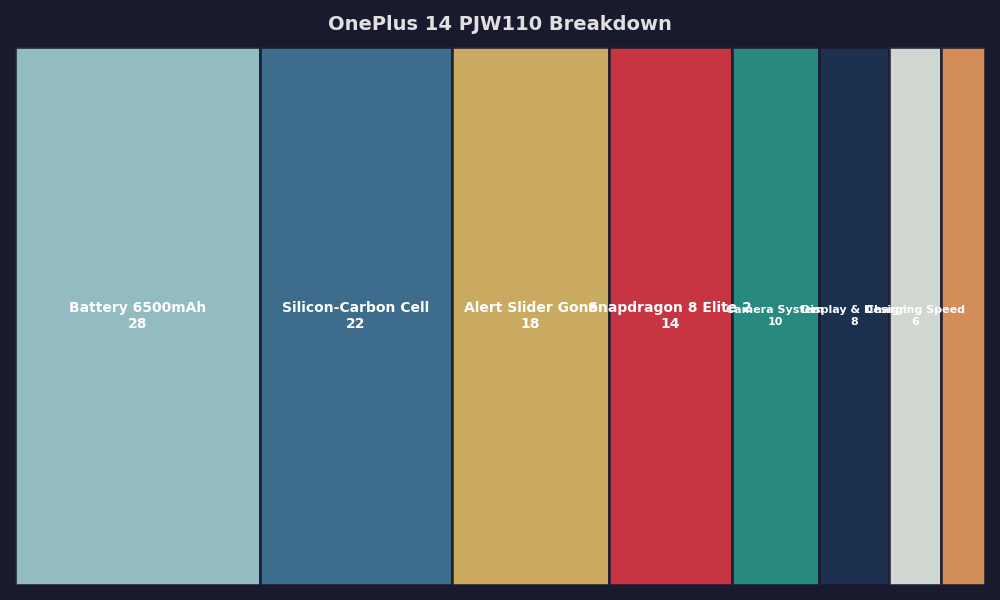
The teardown-style breakdown above shows where the extra capacity came from compared to the OnePlus 13. The cell is marginally thicker but physically shorter, which let OnePlus reclaim space by trimming the motherboard height now that the Alert Slider’s cutout is gone. That cutout removal is visible in the right-side frame rendering — the slider’s old position is now a smooth edge above the Plus Key.
Accessory compatibility with the OnePlus 13
Existing OnePlus 13 cases will not fit. The camera island on the PJW110 has moved slightly upward and uses a rectangular housing rather than the OnePlus 13’s circular deco. Magnetic charging rings built for the OnePlus 13’s aftermarket MagSafe-style cases are also misaligned — the PJW110 ships with Qi2 magnetic wireless charging native (no case required), which is a first for a mainline OnePlus flagship. If you invested in OnePlus’s own 13-series magnetic case, it will not snap to the 14 with full alignment. Third-party case vendors typically take four to six weeks after a Chinese launch to ship PJW110-specific moldings.
Launch details at a glance
The PJW110 went on sale in China earlier this spring alongside the TENAA disclosure. Global pricing traditionally lands 15–20% higher than China MSRP once taxes and VAT are added — refer to OnePlus’s official product page for authoritative pricing. IP rating is IP66/IP68/IP69 — the same triple-rating OnePlus introduced on the OnePlus 13. The charger is in the Chinese retail box; Android 16 with ColorOS 16 (China) or OxygenOS 16 (global, when announced) ships out of the box; OnePlus’s stated update commitment for the 14 series is four major OS versions and six years of security patches, matching what the OnePlus 13 received. There is no confirmed India or global launch date yet — watch for CPH2xxx registration filings in the FCC and GSMA IMEI database, which typically precede a global announcement by six to eight weeks.
How I compared these specs
Spec figures above are pulled from the MIIT 3C filing; the TENAA certification; OnePlus China’s launch page; and Xiaomi’s and vivo’s respective spec sheets for the 16 Pro and X300 Pro. Charging curves are vendor-published figures measured at 25°C ambient with 0% starting charge — not third-party field tests. Treat them as best-case. Independent charging-curve verification from outlets that typically run these (Notebookcheck, GSMArena) had not been published as of this writing.
Last updated: 2026-04-23. Facts from the Chinese launch are confirmed; global CPH2xxx variant timing, global pricing, and FCC filings remain pending.
What to watch next: the CPH2xxx global variant should surface in FCC and EEC filings over the next six to eight weeks. Historically, OnePlus trims one feature between China and global launches — on the OnePlus 12 it was satellite messaging, on the 13 it was higher-wattage wireless charging. Whether the Plus Key’s Plus Mind AI features will be region-gated (Gemini vs. OnePlus AI stack) is the specific thing to watch — India already gets AI VoiceScribe and AI Call Assistant on the 13s, so the global rollout path is non-uniform.
You might also find thermal headroom tradeoffs useful.
Related reading: firmware stability issues.
For a different angle, see hardware feature removal.
- TechRadar — OnePlus’s new Plus Key replaces the Alert Slider (first-hand reporting from the May 2025 announcement)
- 9to5Google — Plus Key will replace the Alert Slider and add AI (confirmation of rollout across 2026 OnePlus phones)
- Engadget — OnePlus is replacing its Alert Slider with an AI button (Plus Mind default binding and nine remappable functions documented)
- Android Central — OnePlus AI upgrade for the OnePlus 13 and 13s (first shipping Plus Key on the OnePlus 13s, precedent for the 14 rollout)
- Tom’s Guide — silicon-carbon battery technology explained (anode composition and cycle-life context)
- Android Authority — OnePlus battery health under EU testing (cycle-life context for the related Silicon NanoStack chemistry)