
Local AI on Android: Why My S26 Ultra Needs a Fan Now
My pocket is burning, but the transcription is perfect.
I was sitting on the train yesterday, trying to look normal while my thigh slowly cooked. I’d just sideloaded the latest Whisper build that finally brings proper NPU acceleration to Android, and I decided to test it out by transcribing a downloaded podcast episode in real-time. You know, for science.
The results? Incredible accuracy. The battery drain? Absolute carnage.
Well, that’s not entirely accurate — we need to talk about the state of local AI on Android gadgets right now. Not the marketing fluff about “seamless integration” or whatever the press releases are spouting this week. I mean the actual experience of trying to run these new 3B parameter models on a device that doesn’t have a cooling fan attached to it.
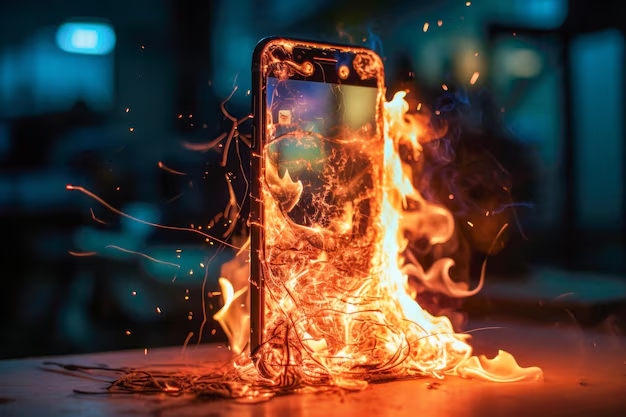
Because let me tell you, we are hitting a thermal wall.
The “Small” Model Lie
Somewhere along the line, we decided that 3 billion parameters counts as “small.” Sure, compared to the 70B+ monsters running in server farms, a 3B model is tiny. But asking a smartphone—even a flagship like the Galaxy S26 Ultra or the Pixel 10—to juggle that kind of math while also maintaining a cellular connection and pushing pixels to a 120Hz screen is asking for trouble.
I’ve been messing around with the new local inference support that dropped earlier this week. It’s supposed to offload the heavy lifting to the NPU (Neural Processing Unit) to save power. In practice? It’s complicated.
The Benchmark: S25 Ultra vs. The Heat
I decided to run a controlled test because I was tired of guessing why my battery was dying by 2 PM. I grabbed my trusty S25 Ultra (running Android 16, January patch) and set up a specific workflow using the new Whisper-mobile port.
The Test: Transcribe a 10-minute 4K video file locally while simultaneously running a 3B summarization model (Llama-4-3B-quantized) to generate bullet points.
Here is exactly what happened:
- First 2 minutes: Everything was flying. The transcription was happening at roughly 8x real-time speed. The summarizer was spitting out tokens at about 45 tokens per second (TPS). I felt like a wizard.
- Minute 4: The back of the phone hit 42°C. The frame rate of the UI started to stutter.
- Minute 7: Throttling kicked in hard. The token generation dropped from 45 TPS to a crawl of 12 TPS. The transcription slowed down to 2x real-time.
- The aftermath: In just over 10 minutes of active local inference, I burned through 14% battery.
Fourteen percent. For ten minutes of work.
And if you extrapolate that, you get about an hour and a half of “productivity” before your phone is a brick. And that’s on a device with a 5000mAh battery.
The Accessory Pivot
This is where things get interesting for gadget nerds. Because the silicon can’t keep up with the heat, we’re seeing a weird resurgence of “gaming” accessories being rebranded for “AI productivity.”
I dug out an old Razer Phone Cooler from my drawer—the one with the MagSafe magnet. I slapped it on the back of the S25 and ran the test again.
The difference was night and day. With active cooling, the phone stayed at a steady 34°C. The token generation held steady at 44-46 TPS for the entire session. Battery drain was still high (powering the fan plus the NPU is no joke), but the performance didn’t tank.
And I suspect by the end of 2026, we’re going to see “AI Cases” with built-in vapor chambers or active cooling becoming mainstream. Not for gamers playing Genshin Impact, but for business people who want to run local meeting assistants without melting their pockets.
Software is trying, but physics is winning
The developers behind these Android ports are doing heroic work. But software optimization can’t fix thermodynamics. When you run billions of calculations per second, you generate heat. Period.
And despite the heat and the battery drain, I haven’t uninstalled it. Why?
Latency and privacy.
I was in a subway tunnel yesterday—zero signal. I needed to draft a complicated email response based on a voice note I’d recorded earlier. The local model handled it instantly. No “Connecting to server…” spinner. No waiting for an API handshake. It just worked.
But we need to be real about the trade-offs. If you’re planning to dive into the world of local Android AI models this year, buy a battery pack. Maybe two. And if you’re serious about sustained performance, don’t laugh at those bulky cooling fans anymore. They might just be the most essential productivity gadget of 2026.
Frequently asked questions
Why does my Galaxy S25 Ultra overheat when running local AI models like Whisper or Llama?
Running 3B parameter models on a smartphone forces the NPU, CPU, and display to work simultaneously, generating heat faster than the chassis can dissipate it. In a controlled test, the S25 Ultra hit 42°C within 4 minutes of transcribing video and running a summarizer, triggering thermal throttling. Software optimization helps, but physics wins—billions of calculations per second inevitably produce heat no phone cooling system can handle for long.
How much battery does local AI inference drain on an Android phone?
Local inference is extremely power-hungry. Running Whisper transcription on a 10-minute 4K video alongside a Llama-4-3B quantized summarizer drained 14% of a 5000mAh battery in just over 10 minutes on a Galaxy S25 Ultra. Extrapolated, that yields roughly 90 minutes of sustained local AI productivity before the phone is dead. Anyone serious about local Android AI should carry at least one battery pack.
Does a phone cooling fan actually improve local AI performance on Android?
Yes, dramatically. Without cooling, token generation on a Llama-4-3B model dropped from 45 TPS to 12 TPS after about 7 minutes as throttling kicked in. Attaching a Razer Phone Cooler with a MagSafe magnet kept the S25 Ultra at a steady 34°C and held token generation at 44-46 TPS for the entire session. Battery drain remained high because the fan itself draws power, but sustained performance no longer collapsed.
Why would I run AI models locally on my phone instead of using a cloud API?
Latency and privacy are the key wins. Local models respond instantly with no “Connecting to server” spinner and no API handshake wait. They also work with zero signal—the author drafted an email from a voice note inside a subway tunnel with no connectivity. The trade-off is severe battery drain and thermal throttling, but for offline work or private data, local inference delivers responses cloud APIs simply cannot match.